

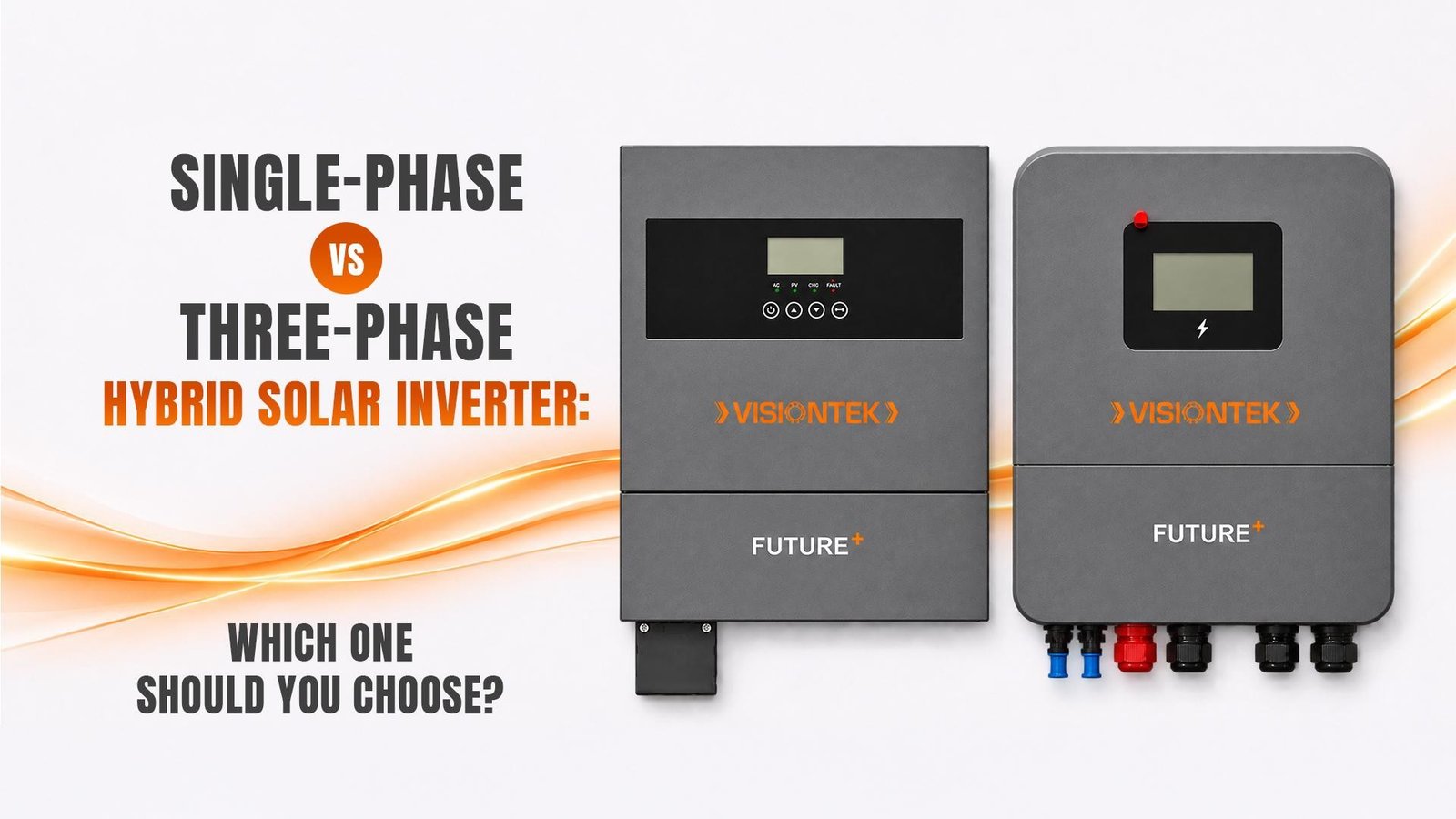
Introduction: Choosing the Right Hybrid Solar Inverter
Solar energy is moving beyond electricity generation. Customers increasingly want to generate solar power, store excess energy, reduce grid dependence, and maintain essential power during outages.
A Hybrid Solar Inverter combines solar conversion, battery charging and discharging, and power management. The right choice depends on the electrical connection, connected loads, backup requirements, solar capacity, battery system, and future energy needs.
Should you choose a Single Phase Hybrid Solar Inverter or a Three Phase Hybrid Solar Inverter?
What Is a Hybrid Solar Inverter?
A Hybrid Solar Inverter integrates solar energy conversion, battery charging/discharging, and power management. Depending on the model, it can manage energy from solar panels, batteries, the utility grid, and backup loads.
- Solar generation
- Battery storage
- Utility grid
- Backup or essential loads
During an outage, a suitably designed hybrid system can supply designated backup loads. Backup capability depends on the inverter, battery, and connected load; it does not automatically mean that every circuit will remain powered.
Single-Phase vs Three-Phase Hybrid Solar Inverter
Single-Phase Hybrid Solar Inverter
Single-phase Hybrid Solar Inverter systems are designed for single-phase electrical systems and are commonly considered for homes, small businesses, offices and appropriately sized applications.
- Independent houses
- Small offices and retail shops
- Small clinics and home offices
- Essential-load backup systems
An IP66 single-phase hybrid solar inverter may also be considered for suitable installations, subject to the product specifications and environmental protection requirements.
A solar inverter for home should be selected according to the household's connected load, backup requirements and electrical configuration.
Three-Phase Hybrid Solar Inverter
Three-phase Hybrid Solar Inverter systems are designed for three-phase electrical systems and may be relevant for larger residences, commercial buildings, workshops, farms and industrial applications.
- Large residences and villas
- Commercial and institutional buildings
- Workshops and warehouses
- Agricultural pumping and compatible industrial loads
The actual backup configuration, phase balancing, and permitted unbalanced load must be verified for the selected model.
The IP66 three-phase hybrid solar inverter may also be considered for suitable installations, subject to the product specifications and environmental protection requirements.
3. Key Difference: Single-Phase vs Three-Phase
| Parameter | Single-Phase Hybrid | Three-Phase Hybrid |
|---|---|---|
| Electrical connection | Single-phase | Three-phase |
| Common application | Homes, small offices, shops | Large homes, commercial and industrial sites |
| Load arrangement | Single-phase loads | Three-phase and single-phase loads, subject to design |
| Motor applications | Model and load dependent | Suitable for compatible three-phase motor applications |
| Backup design | Often essential circuits | Selected or multiple phases, subject to model |
| Main design issue | Load and surge capacity | Phase distribution, balance and protection |
| Battery compatibility | Must match inverter specifications | Must match inverter specifications |
Three-phase does not automatically mean that one single-phase circuit can receive the full rated capacity. Output per phase and permitted imbalance must be checked in the datasheet.
How Much Load Can a Hybrid Solar inverter Support?
An inverter's kW rating represents its designed power output under specified conditions. It does not mean that every appliance can be operated simultaneously regardless of starting current.
| Load | Illustrative Power |
|---|---|
| 4 fans | 280 W |
| 6 LED lights | 60 W |
| Refrigerator | 200 W |
| Wi-Fi router | 15 W |
| Television | 120 W |
| Computer | 150 W |
| Estimated running load | 825 W |
The example is illustrative. The customer must also consider compressor or motor starting current, future appliances, air conditioners, pumps, total simultaneous load, and inverter surge capability.
For a commercial building, the designer must identify which loads are single-phase and which are three-phase. A 15 kW three-phase inverter cannot automatically be assumed to provide 15 kW to one single-phase circuit.
How to Choose the Correct Hybrid Solar Inverter Rating?
Step 1: Calculate the running load
List each appliance, rated power, quantity, operating hours, and whether it is essential during an outage. Add the loads expected to operate simultaneously.
Step 2: Identify starting loads
Pumps, refrigerators, compressors, air conditioners, and motors may draw higher starting current. Check the inverter's surge capability.
Step 3: Define the backup objective
Decide whether the customer needs essential-load backup or wider property/commercial backup.
Step 4: Check technical compatibility
Review continuous output, surge capacity, PV voltage/current, MPPT range, battery voltage, charge/discharge current, phase arrangement, and protection requirements.
The right Hybrid Solar Inverter should also match the application's electrical configuration and backup requirements.
A 6.2 kw hybrid solar inverter should be evaluated against the connected load, battery capacity and backup requirements before selection.
How to Select Battery Capacity?
Inverter capacity is measured in kW and indicates the power that can be delivered at a time. Battery capacity is measured in kWh and indicates stored energy, subject to operating limits.
Illustrative example: a 2 kW essential load for 4 hours requires approximately 8 kWh of energy before accounting for efficiency, depth of discharge, ageing, temperature and reserve capacity.
The battery must also have sufficient power capability for the connected load and must be compatible with the inverter's voltage range, current limits and BMS communication.
How Should a Customer Decide?
What type of electricity connection is available?
Confirm whether the site is single-phase or three-phase and select a compatible inverter.
What is the actual connected load?
Prepare an equipment list and calculate the simultaneous operating load.
What must operate during a power cut?
Define whether the customer needs lights and fans, computers, pumps, air conditioning, commercial equipment or multiple phases.
What is the future requirement?
Consider EV charging, more appliances, additional solar panels, and battery expansion where supported.
What are the installation requirements?
Verify protection, metering, wiring, utility requirements, and equipment compatibility.
VISIONTEK FUTURE+ Hybrid Energy for Evolving Requirements
The future of energy is moving toward integrated systems combining solar generation, battery storage, and intelligent energy management.
VISIONTEK FUTURE+ Hybrid Solar Inverter solutions, together with compatible LiFePO4 battery storage, are positioned within this solar-plus-storage ecosystem. Selection should be based on inverter power, backup load, battery energy and power, phase arrangement, PV configuration, installation requirements, monitoring, and service support.
Visiontek Solar solutions form part of the evolving solar energy ecosystem, with selection guided by application requirements and product specifications.
Conclusion
Choosing between a Single Phase Hybrid Solar Inverter and a Three Phase Hybrid Solar Inverter is not simply a matter of selecting a higher or lower capacity. It is about matching the electrical system to the customer's energy requirements.
A single-phase Hybrid Solar Inverter may be suitable for appropriately designed residential and small commercial applications. A three-phase Hybrid Solar Inverter may be relevant for larger buildings, distributed loads, and compatible three-phase equipment.
Frequently Asked Questions
Is a three-phase Hybrid Solar inverter always better?
Neither configuration is universally suitable. The correct choice depends on the electrical supply, load arrangement, capacity, backup requirements, and compatibility.
Can a single-phase Hybrid Solar inverter support a three-phase house?
Not automatically. The proposed electrical design and the inverter's permitted connection arrangement must be verified.
Can a three-phase inverter run single-phase loads?
Many can, but permitted load distribution and unbalanced-load capability are model-specific.
How many kW do I need for my home?
Start with essential and simultaneous running loads, then assess starting current, future requirements, surge capability, and battery power.
Does a bigger inverter mean longer backup?
No. Backup duration primarily depends on battery energy and the load being supplied.
Can batteries be added later?
Only if the inverter, battery architecture, BMS compatibility, and expansion limits support it.
Can Hybrid Solar inverters support pumps and motors?
Some can support compatible motor loads after checking starting current, power, phase, and surge capability.
What is the role of LiFePO4 batteries?
LiFePO4 is a lithium iron phosphate chemistry used in energy storage. The battery must meet the required energy, power, safety, and compatibility requirements.
What should I ask an installer?
Ask for load assessment, inverter rating, battery capacity, backup estimate, PV sizing, phase arrangement, protection, warranty, monitoring, and expansion options.