

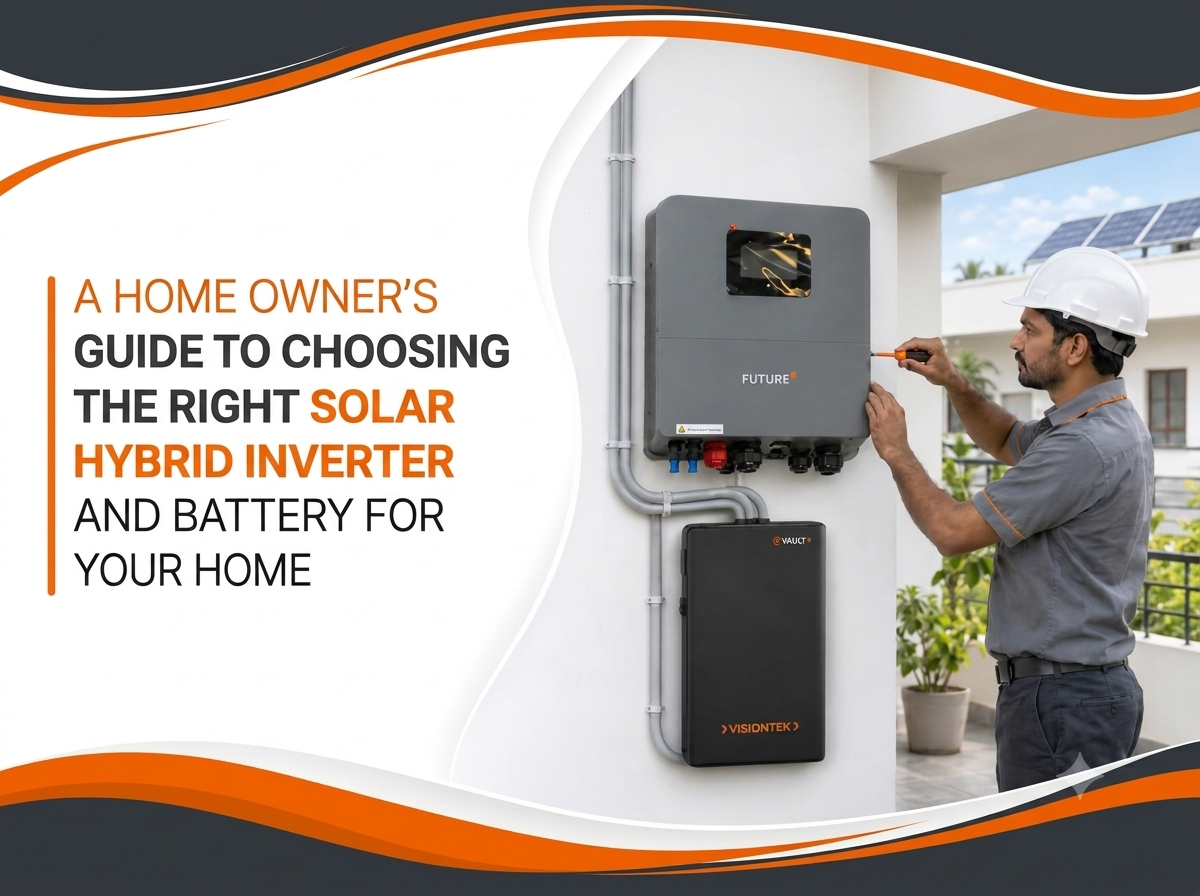
Before buying an inverter or battery, the single most important question is: "What exact rating do I need to run my home load comfortably without trips or blackouts?"
Whether you are a homeowner avoiding costly mistakes, an electrician on-site, or an engineer designing a hybrid system— here is the 4-step field guide to getting inverter and battery sizing right the first time. Most inverter problems at home are not product failures. They are sizing failures: an inverter that trips when the water pump starts, or a battery that is flat after one hour of a power cut.
This guide shows you how to size both correctly, using Indian household conditions (230 V, 50 Hz single-phase).
The four numbers that decide everything:
- Running load (W): Total Wattage of everything that can be on at the same time.
- Surge load (W): The short, higher power drawn when a motor or compressor starts.
- Backup energy (Wh): Running watts multiplied by the hours you want backup.
- System voltage (V): 12 V, 24 V, or 48 V, which depends on the inverter size.
The inverter is chosen by numbers 1 and 2 (Power). The battery is chosen by numbers 3 and 4 (Energy).
Step 1: Audit Your Loads
Typical values for Indian homes are below. These are representative figures; always check the nameplate or the energy label of your own appliance.
| Appliance | Typical running power (W) | Surge multiple | Peak at start (W) | Put on battery backup? |
|---|---|---|---|---|
| LED bulb | 9 | 1x | 9 | Yes |
| LED tube light | 20 | 1x | 20 | Yes |
| Ceiling fan (regular) | 75 | 1.5x | 110 | Yes |
| Ceiling fan (BLDC) | 30 | 1x | 30 | Yes |
| LED TV (43 inch) | 80 | 1x | 80 | Yes |
| Wi-Fi router | 12 | 1x | 12 | Yes |
| Laptop | 65 | 1x | 65 | Yes |
| Refrigerator (about 250 L) | 200 | 3x to 4x | 600 to 800 | Yes |
| Water pump 0.5 HP | 550 | 3x | 1,650 | Yes, but short runs |
| Water pump 1 HP | 1,000 | 3x | 3,000 | Plan carefully |
| Mixer grinder | 500 | 2x | 1,000 | Occasionally |
| Washing machine | 500 | 2x | 2,000 | Optional |
| Inverter AC 1.5 ton | 1,400 | 1.5x to 2x | 2,100 to 2,800 | Large system only |
| Non-inverter AC 1.5 ton | 1,800 | 3x to 4x | 5,400 to 7,200 | Avoid on backup |
| Geyser or induction cooker | 1,500 to 2,000 | 1x | same | No (heating loads drain batteries fast) |
Thumb rule for installer and field engineers: Keep heating loads (geysers, room heaters, irons, induction stoves) strictly on the raw grid or a large solar-direct feed—never on battery backup.
Step 2: Calculate Running Load and Peak Surge
Running load = sum of the watts of all appliances that can run together.
Peak surge = Running load minus the largest motor + (Startup surge wattage of that largest motor).
We add only the largest motor, because two motors rarely start in the same second.
Step 3: Size the Inverter
Design load (W) = Running load x 1.25 (25% margin for growth and derating)
Inverter size (VA) = Design load / 0.8 (typical household power factor)
Then verify surge: Inverter surge capacity ? Peak surge
Good inverters typically hold 1.5x to 2x of rating for a few seconds. Confirm this on the datasheet.
Reading the rating: Many Indian inverters are rated in VA at a 0.8 power factor, so a 2 kVA unit gives about 1.6 kW. Many hybrid solar inverters are rated in kW directly. Always compare in watts when choosing the best inverter for home setups.
Worked example: A 2BHK home
| Load | Qty | Watts each | Total (W) |
|---|---|---|---|
| LED bulbs | 6 | 9 | 54 |
| Ceiling fans | 3 | 75 | 225 |
| LED TV | 1 | 80 | 80 |
| Wi-Fi router | 1 | 12 | 12 |
| Laptop | 1 | 65 | 65 |
| Refrigerator | 1 | 200 | 200 |
| 0.5 HP pump | 1 | 550 | 550 |
| Running total | 1,186 |
- Peak surge: (1,186 - 550) + 1,650 = 2,286 W
- Design load: 1,186 x 1.25 = 1,483 W
- Inverter: 1,483 / 0.8 = 1,853 VA, so choose a 2 kVA (about 1.6 kW) inverter
- Surge check: 2 kVA at 2x gives about 3.2 kW, which is above 2.29 kW. Passed.
Step 4: Size the Battery
First, calculate the energy you need during a power cut.
| Load | Watts | Hours of backup | Energy (Wh) |
|---|---|---|---|
| LED bulbs | 54 | 4 | 216 |
| Fans | 225 | 4 | 900 |
| TV | 80 | 2 | 160 |
| Router | 12 | 4 | 48 |
| Laptop | 65 | 3 | 195 |
| Refrigerator (about 50% duty) | 200 | 4 x 0.5 | 400 |
| Pump | 550 | 0.5 | 275 |
| Total backup energy | 2,194 Wh |
Then apply the battery formula:
- Battery energy (Wh) = Load energy (Wh) / (DoD x Inverter efficiency)
- Battery Ah = Battery Wh / System voltage
| Parameter | LiFePO4 | Tubular lead-acid |
|---|---|---|
| Usable depth of discharge (DoD) | 90% | 50% |
| Inverter efficiency | 90% | 90% |
| Combined factor | 0.81 | 0.45 |
| Cycle life (typical) | 3,000 to 6,000 cycles | 1,000 to 1,500 cycles |
| Weight and space | Light, compact | Heavy, bulky |
For our 2BHK example:
- LiFePO4: 2,194 / 0.81 = 2,709 Wh. At 25.6 V, this is about 106 Ah, so choose a 25.6 V, 120 Ah (about 3 kWh) pack.
- Lead-acid: 2,194 / 0.45 = 4,876 Wh. At 24 V, this is about 203 Ah, so you need two 12 V, 200 Ah batteries in series.
The same backup needs almost half the stored energy with LiFePO4, because you can use far more of it each cycle—making a lithium battery for inverter backup a space-saving choice.
System voltage: a quick rule
| Inverter size | Recommended battery bus |
|---|---|
| Up to 1 kVA | 12 V |
| 1.5 to 2.5 kVA | 24 V |
| 3 kVA and above | 48 V |
Higher voltage means lower current, thinner cables, lower losses, and a safer design.
Check the discharge rate
Battery current at full load = Inverter load (W) / 0.9 / System voltage. In the example: 1,186 / 0.9 / 25.6 = about 51 A, which is 0.43C on a 120 Ah LiFePO4 pack. That is comfortable. Always keep continuous discharge within the battery maker's rating, and make sure the battery BMS supports the inverter surge current.
The quick selection chart
Assumes 4 hours of backup and an average running load as shown.
| Home profile | Avg. load (W) | Inverter | Battery bus | LiFePO4 for 4 h | Lead-acid equivalent |
|---|---|---|---|---|---|
| 1BHK essentials (lights, fans, TV, router) | 350 | 1 kVA | 12 V | about 1.9 kWh (12.8 V, 150 Ah) | about 260 Ah at 12 V |
| 2BHK with fridge | 800 | 1.5 kVA | 24 V | about 4 kWh (25.6 V, 160 Ah) | about 300 Ah at 24 V |
| 3BHK with pump | 1,500 | 2.5 kVA | 48 V | about 7.5 kWh (51.2 V, 150 Ah) | about 280 Ah at 48 V (8 batteries) |
| Villa with inverter AC | 2,500 | 5 kVA | 48 V | about 12.3 kWh (51.2 V, 240 Ah) | Impractical: about 460 Ah at 48 V |
Assumption: Inverter VA = load x 1.25 / 0.8, rounded up to the next standard size. Battery Wh = load x 4 h / 0.81 for LiFePO4 (or / 0.45 for lead-acid).
Adding Solar: The PV Array
For a solar hybrid system, size the panels to the energy you use in a day, not only the backup energy.
PV size (kWp) = Daily energy (kWh) / (Peak sun hours x Performance ratio)
- Peak sun hours across most of India: about 4.5 to 5.5 per day (use 5 as a working value; check your city).
- Performance ratio: about 0.75 to 0.80 after losses.
- Rule of thumb: 1 kWp generates roughly 4 to 5 units (kWh) per day, and needs about 100 sq. ft (10 sq. m) of shadow-free roof.
Example: A home using 8 kWh a day needs 8 / (5 x 0.75) = 2.13 kWp, so about 4 panels of 540 Wp (2.16 kWp). Check the solar inverter for home datasheet for the maximum PV input and MPPT voltage window before finalising.
Which inverter type fits?
- On-grid inverter: lowest cost, best payback, but no output during a grid outage.
- Hybrid inverter: solar, grid and battery in one box, for homes with regular power cuts.
- Micro inverter: panel-level conversion, ideal for shaded or multi-orientation roofs.
Thumb Rules to Remember
- Inverter VA = Running watts x 1.25 / 0.8, then check surge against the largest motor.
- Battery Wh = Load Wh / 0.81 for LiFePO4, or / 0.45 for lead-acid.
- Use 12 V up to 1 kVA, 24 V for 1.5 to 2.5 kVA, 48 V for 3 kVA and above.
- Never put geysers, heaters, or induction cooktops on battery backup.
- Add only one motor surge, the largest one, to the running load.
- Solar: 1 kWp gives about 4 to 5 kWh a day and needs about 100 sq ft.
Common Mistakes to Avoid
- Sizing on the AC rating alone and ignoring the compressor start current.
- Adding everything in the house to the backup load. Decide what is truly essential.
- Mixing old and new batteries or different capacities in one bank.
- Ignoring ambient temperature. Batteries degrade faster in hot, closed spaces.
- Undersized cables and MCBs, which cause heating and voltage drop at high DC currents.
Frequently Asked Questions
Can I run a 1.5 ton AC on a 2 kVA inverter?
A non-inverter AC will usually trip it on start-up. An inverter AC may run, but with little headroom for anything else. Choose 3 kVA or higher.
How many hours of backup will I get?
Backup hours = (Battery kWh x 0.81) / load in kW for LiFePO4. A 3 kWh pack at 600 W gives about 4 hours.
Is LiFePO4 worth the higher price?
Per usable kWh and per cycle, usually yes, because of higher usable capacity, longer life, and lower maintenance—especially when investing in a solar lithium battery. Compare cost per cycle, not just price tag.
What happens to my hybrid inverter and battery system during a major grid power surge or lightning strike?
Power surges can fry sensitive inverter boards and BMS controllers. Always ensure your installation includes certified Type II AC and DC Surge Protection Devices (SPDs) and a dedicated, low-resistance chemical earthing pit (ideally < 5>
Why does my inverter trip on "Overload" even though my total running load is below its rated capacity?
This almost always happens due to unaccounted motor startup surges (such as a refrigerator compressor, water pump, or washing machine starting simultaneously). Ensure you add the startup surge of the single largest motor to your running total during sizing, rather than looking only at steady-state wattage.
Do I need a separate distribution board (DB) wiring modification for a hybrid inverter backup?
Yes. To prevent overloading your inverter during a power cut, an electrician must segregate your home wiring into "Essential Loads" (fans, lights, fridge, router) routed through the inverter output, and "Non-Essential Loads" (geysers, heavy heaters, ACs) left strictly on the direct grid feed.
Whether you are a homeowner investing in energy independence, an electrician setting up a residential system on-site, or an engineer designing a robust hybrid network, taking the time to calculate these numbers ensures safety, reliability, and long-term value.
At Visiontek Solar, we believe solving power problems starts with understanding your home's true energy requirement. Before installing your system, always verify equipment datasheets, set up proper protection devices, and consult a qualified expert—because a well-built solar and storage setup gives you lasting peace of mind.